
Trusted Ventura Hard water Fixes for Healthier Pipes and Better Pressure
Hard water is one of those problems that sneaks up on Ventura homeowners. One day the shower feels fine. Then the spray gets weaker, the hot water takes longer, and white crust starts showing up on fixtures no matter how often you clean. This post explains what’s happening locally, how to confirm it with simple tests, and which solutions actually protect your plumbing. The goal is fewer clogs, steadier flow, and a home that works the way it should with Ventura Hard water Fixes you can trust.
This is practical, homeowner-first guidance. If you want a tailored diagnosis, Smart Choice Plumbing & Drains can test your hardness and pressure, then walk you through options that fit your home and budget today.
Table of Contents
- Why Ventura water tends to be hard
- What hard water does to pipes, fixtures, and pressure
- How to diagnose hard water vs a true pressure problem
- Weekend fixes that often restore flow fast
- Whole-home solutions and which one fits your goals
- Quick decision guide for Ventura homes
- What a professional plumbing check should include
- A quick Ventura example
- Ventura discharge considerations
- Maintenance that keeps performance steady
- Quick FAQs
Why Ventura water tends to be hard
Ventura’s water hardness is driven by the mineral content in its blended sources. In the City of Ventura’s 2024 Consumer Confidence Report (data collected in 2023), hardness is listed around 263 ppm (15 grains per gallon) for Casitas water, around 445 ppm (26 gpg) for Ventura River groundwater, and around 637 ppm (37 gpg) for treated groundwater. That range is why hardness can feel different across neighborhoods and seasons.
Using the common U.S. Geological Survey guideline, anything above about 180 mg/L is “very hard.” In plain terms, Ventura water often has plenty of dissolved minerals, so scale is not a fluke. It’s a predictable outcome of normal daily use.
If you can scrape a chalky ring off a faucet, or if you’re constantly wiping cloudy glass and shower doors, you’re seeing the same mineral process that can happen inside pipes. The Ventura Hard water Fixes that work best start with accepting a simple reality: the water itself is not “bad,” but it is persistent about leaving minerals behind.
What hard water does to pipes, fixtures, and pressure
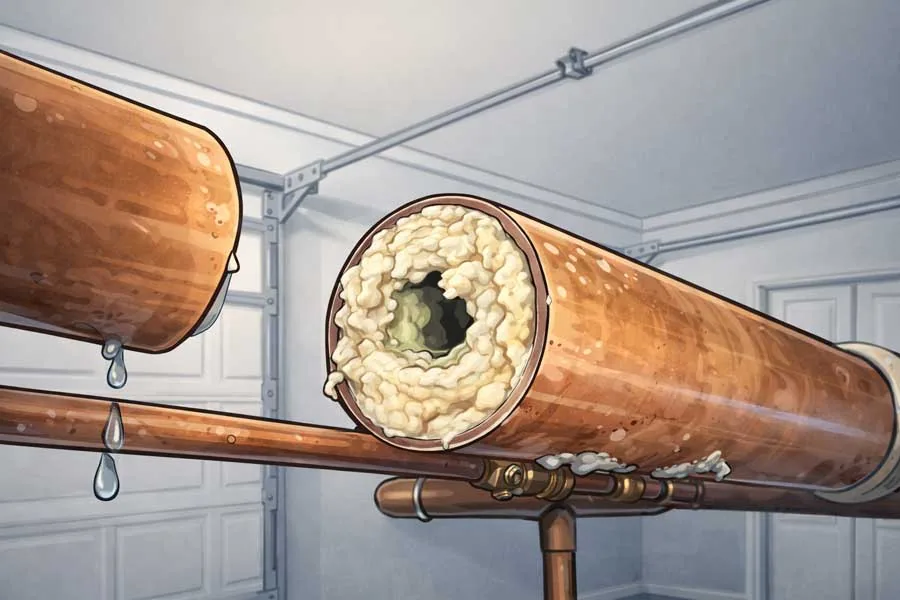
Hard water doesn’t reduce pressure everywhere on day one. What it does is build restrictions. Calcium carbonate can deposit on heating elements, inside tankless heat exchangers, at shutoff valves, in faucet aerators, in shower cartridges, and inside small-diameter supply lines. Those are tight passages, so a little buildup can make a big difference in “felt pressure” at the fixture.
Common hard-water impacts in Ventura homes and small businesses include:
- Lower flow at showers and faucets: aerators, showerheads, and cartridges clog first.
- Hot water gets weaker before cold: heat speeds up scale formation.
- Water heaters lose efficiency: scale insulates heating surfaces and can cause rumbling or popping sounds.
- More repairs over time: gritty cartridges, sticky valves, and leaking fixtures show up more often.
If your home has older galvanized steel piping, scale and corrosion can work together. Galvanized lines can narrow from the inside as they age, and hard-water scale can add another layer of restriction. In that situation, “better pressure” is often a mix of clearing choke points, protecting the water heater, and sometimes planning for a long-term repipe.
How to diagnose hard water vs a true pressure problem
Before you buy equipment, get two simple data points: hardness and base pressure. This keeps you from spending money on treatment when the real issue is a failing pressure-reducing valve (PRV) or a partially closed main shutoff.
- Test hardness at the tap: a basic strip test gives a ballpark in grains per gallon. A lab test reports mg/L (ppm) as CaCO3.
- Check pressure at a hose bib: a screw-on gauge at an outdoor spigot shows static pressure with everything off. Turn on a faucet and see the dynamic drop.
- Compare hot vs cold at the same fixture: strong cold with weak hot often points to scale in the water heater, tankless unit, or hot-side valves.
- One fixture vs whole house: one weak sink is usually a local restriction; multiple weak fixtures can be a pressure supply, PRV, or main restriction.
Helpful distinction: pressure is the force in the line, while flow is how much water actually makes it through. Hard-water scale usually reduces flow by narrowing passages. A failing PRV can reduce pressure for the whole house. A clogged filter can do both. Knowing which one you have keeps your fix targeted and prevents wasted upgrades.
If static pressure at the hose bib is healthy but a shower is weak, you likely have a fixture restriction, and the fastest Ventura Hard water Fixes start with cleaning and targeted replacement. If static pressure is low at the hose bib, address the PRV, meter, or supply-side restriction first because treatment will not create pressure that is not there.
Weekend fixes that often restore flow fast
These are safe, practical steps many homeowners can do without specialty tools. They won’t “cure” hardness, but they can restore comfort quickly while you decide on a long-term solution.
- Clean faucet aerators: remove the aerator, rinse debris, and soak parts in white vinegar if you see crust. Scrub gently and reassemble.
- Soak showerheads: a vinegar soak helps dissolve surface scale in spray nozzles. Rinse thoroughly afterward.
- Check angle stops: partially restricted shutoff valves under sinks can cut flow. If a fixture is weak and the aerator is clean, the angle stop can be the culprit.
- Service the water heater as needed: tank heaters may benefit from flushing; tankless units often need periodic descaling in very hard water.
If cleaning restores flow but the problem returns, that’s your cue to move from “symptom fixes” to “source control.” That’s where whole-house Ventura Hard water Fixes deliver the biggest payoff.
Whole-home solutions and which one fits your goals
Not every “soft water” product does the same job. Here are the options that matter, explained without the marketing fog.
1) Ion-exchange water softener (true softening). This is the most proven way to remove hardness minerals. The system exchanges calcium and magnesium for sodium or potassium using resin. If you want better soap performance, fewer spots, and the strongest reduction in scale potential, this is usually the top choice. It’s also one of the best protections for tankless water heaters in very hard water.
2) Salt-free scale conditioning (scale reduction, not mineral removal). Many “salt-free softeners” are actually conditioners, often using template-assisted crystallization (TAC) media. These systems typically do not reduce hardness readings on a test strip, but they aim to reduce the tendency for calcium carbonate to stick to surfaces. Results can vary by water chemistry and usage, but they’re a common choice when brine discharge is restricted.
3) Whole-house filtration (supporting role). Sediment filtration protects fixtures and valves from grit. Carbon filtration can improve taste and odor. Filtration doesn’t remove hardness, but it helps prevent debris-related clogs. If you want a different taste profile for drinking and cooking, point-of-use reverse osmosis at the kitchen sink can be added later.
Sizing tip: treatment works best when it’s sized to your measured hardness and household usage. Too small means breakthrough and scale. Too large means wasted salt or media life.
Quick decision guide for Ventura homes
If you’re stuck, use this checklist. It keeps your decision on results, not marketing claims.
- Your top goal: do you care most about fewer spots and better soap performance, or mainly about reducing scale in plumbing?
- Your hot-water setup: tankless systems and recirculation loops are more sensitive to hardness and often benefit from stronger scale prevention.
- Your pressure symptoms: if only one fixture is weak, fix that first. If many fixtures are weak, confirm base pressure and PRV health.
- Your sewer district rules: confirm whether on-site brine discharge is allowed at your address before selecting a self-regenerating softener.
- Your maintenance tolerance: softeners require salt and settings checks. Conditioners often require less routine attention.
- Your timeline: if you need immediate relief, clean choke points now, then choose a whole-house strategy to prevent repeat buildup.
What a professional plumbing check should include
If you’ve tried cleaning and pressure still feels inconsistent, a pro visit should be more than swapping a part. A good plumber treats this like a diagnosis, not a guess.
- Pressure and PRV check: confirm static and dynamic pressure at a hose bib and verify PRV operation.
- Restriction check: inspect aerators, cartridges, angle stops, and shutoffs for scale and debris.
- Hot-water check: evaluate tank or tankless performance and service history, plus evidence of sediment or scale.
- Pipe review: identify galvanized sections or internal narrowing that could justify targeted replacement or repiping.
You should leave with a clear plan that separates “restore flow now” from “prevent the next buildup.”
A quick Ventura example
A common Ventura scenario looks like this: hose bib pressure is fine, but two fixtures are weak, and hot water feels worse than cold. Aerators are packed with chalky grit, and the water heater is noisy. The fix is layered: clean or replace the restricted aerators and cartridges, service the heater, then add a whole-home approach so scale does not rebuild. The “pressure win” comes from clearing the choke points and keeping them clear.
If you want help diagnosing a stubborn case, start with a local plumber Ventura trusts, who can measure base pressure, pinpoint restrictions, and recommend the right long-term approach for your address.
Ventura discharge considerations
One Ventura-specific wrinkle is wastewater and brine. Some agencies restrict brine discharge from self-regenerating softeners because salts can complicate wastewater treatment and recycling. Because rules can vary by address and sewer district, it’s smart to confirm what’s allowed before you install a system that regenerates on-site.
The best Ventura Hard water Fixes are the ones that fit your plumbing goals and your local requirements, so you can keep them in place long-term. If on-site brine discharge is restricted, consider salt-free conditioning or an exchange-tank service where regeneration happens off-site in an approved facility.
Maintenance that keeps performance steady
Hard water is not “set it and forget it,” even with the right system. Maintenance is what keeps flow steady.
- Replace filters on schedule: clogged filters reduce flow.
- Check treatment settings: confirm the system matches your household size and hardness.
- Service tankless heaters regularly: very hard water makes routine descaling important.
- Recheck base pressure annually: a simple gauge can spot a failing PRV early.
Quick FAQs
Is hard water dangerous to drink?
Major health authorities generally treat hardness as a nuisance parameter, not a safety threat, at typical drinking-water levels.
Why is my hot water weaker?
Heat accelerates scale formation, so restrictions often show up in the hot-water system first.
Will vinegar fix hard water?
Vinegar helps remove surface scale on fixtures, but long-term results come from preventing scale at the point of entry.
When should I call a plumber?
If base pressure is low at the hose bib, if multiple fixtures are weak, or if you have a tankless heater that hasn’t been descaled in hard water, it’s worth getting a professional diagnosis.
Wrap-up
Ventura’s water hardness can be intense, and that means scale control is a real part of home maintenance. Start with simple cleaning and a pressure gauge check, then choose a whole-house strategy that fits your goals and local discharge realities. With the right approach, Ventura Hard Water Fixes can restore better flow now and protect your plumbing for the long haul.
Sources
Source URLs (reference list)
- City of Ventura. 2024 Consumer Confidence Report (data collected in 2023)
- U.S. Geological Survey. Hardness of Water
- World Health Organization. Hardness in drinking-water background document (NCBI Bookshelf)
- Boluda-Botella N. et al. Paper listing (Google Scholar)
- Virginia Cooperative Extension. Hardness in Household Water (2019) (PDF)