
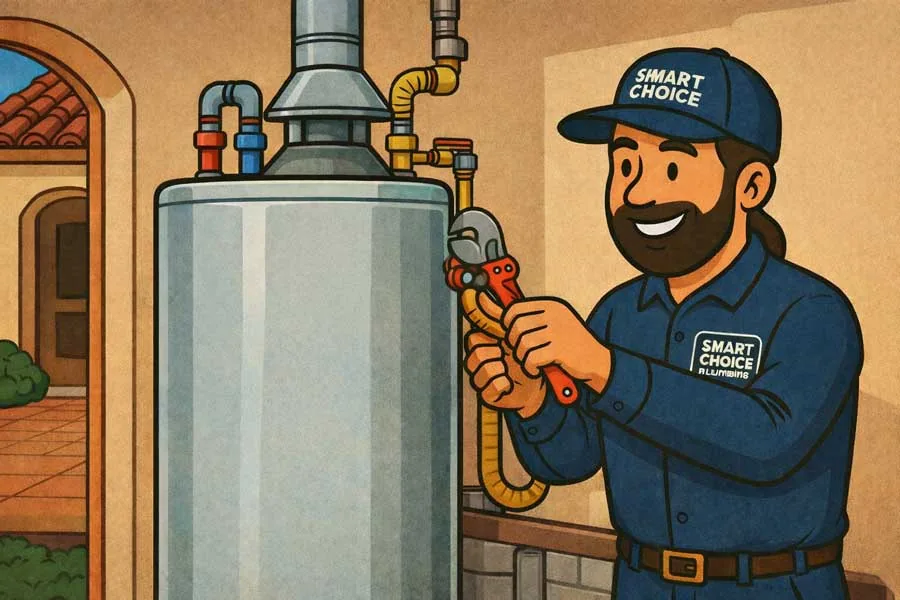
Water Heater Repair in Ventura: What to Look For, What Can Be Fixed, and When to Upgrade
A water heater usually gives you a few warnings before it quits completely. The trick is knowing which signs mean “simple repair,” which ones point to “replace it soon,” and which ones are an immediate safety problem. This Ventura-focused guide walks you through the most common issues, what a good plumber will check, and how to decide if a tankless upgrade is worth it for your home.
And if you want a local team that knows Ventura homes (from Pierpont to Midtown to East Ventura), Smart Choice Plumbing & Drains can help. If you need a plumber ventura homeowners can count on for honest diagnostics and clean installs, we’re here.
Table of Contents
- Ventura factors that affect water heaters
- Quick safety checks before you do anything
- Common water heater problems and what they usually mean
- What a pro checks during a water heater repair visit
- Repair vs. replace: how to decide without guessing
- Tankless water heater upgrade in Ventura: the real pros and cons
- Maintenance that prevents breakdowns (especially with mineral buildup)
- Ventura permits and “inspection day” basics
- How to choose a reliable water heater repair company
- Ventura water heater repair FAQs
- Next steps: what to do today
- Sources
Ventura factors that affect water heaters
Ventura water heaters deal with a mix of everyday wear and a few local realities that make certain problems show up more often.
1) Mineral content and scale buildup. When water has more dissolved calcium and magnesium, it can leave mineral deposits (scale) inside a tank, on electric heating elements, and inside tankless heat exchangers. Scale acts like insulation on the parts that need to transfer heat. That often leads to slower recovery time, higher energy use, temperature swings, and shorter equipment life.
2) Coastal corrosion. If you’re closer to the coast, salty air and moisture can speed up corrosion on exposed fittings, vent components, and exterior cabinet parts. It does not ruin every water heater, but it can make small problems become big problems faster.
3) Older plumbing and remodel layers. Ventura has a wide range of housing ages. In some homes, you have older piping, older shutoff valves, or a water heater tucked into a tight closet with limited access. That affects repair time and also affects what “code upgrades” are required when a replacement happens.
4) Earthquake bracing rules. In California, water heaters must be braced/strapped to resist earthquake movement. If your heater is older, the straps might be missing, installed incorrectly, or using outdated methods.
Quick safety checks before you do anything
Before troubleshooting, take 30 seconds to make sure you are not dealing with a safety emergency. If any of these are true, stop and call a professional right away.
- You smell gas: Leave the area and contact the gas utility from outside, then call a plumber.
- Your carbon monoxide alarm is going off: Get fresh air and treat it as urgent.
- Water is dripping onto electrical components: Turn off power at the breaker and call for service.
- The temperature and pressure relief valve is discharging steadily: A small drip can happen occasionally, but a steady stream means pressure or temperature is not under control.
- The tank is bulging, severely rusted, or actively leaking: Tanks do not “heal.” A leak usually means replacement.
If you are unsure whether you have a gas smell or just a little “hot metal” odor, play it safe. Gas appliances are not the place to guess.
Common water heater problems and what they usually mean
Here are the issues Ventura homeowners ask about the most, plus what is commonly behind them. This is not meant to replace a diagnosis, but it will help you understand what a plumber is talking about.
Problem: No hot water
Gas water heaters: The pilot may be out, the igniter may be failing, the flame sensor may be dirty, the gas control valve may be malfunctioning, or there may be a venting or combustion-air issue that prevents safe operation.
Electric water heaters: A breaker may have tripped, a high-limit reset may have popped, a thermostat may have failed, or a heating element may be burned out.
What you can check safely: Look for an error code (if your unit has a display), check whether the breaker is tripped (electric), and confirm the gas shutoff is open (gas). Do not open sealed combustion areas or adjust gas valves yourself.
Problem: Not enough hot water, or it runs out too fast
This is often blamed on a “small tank,” but the culprit is frequently scale or sediment reducing the usable hot water volume and slowing heating performance.
- Sediment/scale: Mineral buildup steals capacity and reduces heat transfer.
- Thermostat set too low: The tank may be fine, it is just set conservatively.
- Dip tube issues: In some older tanks, a broken dip tube can mix hot and cold water too quickly.
- Household demand changed: New occupants, a new soaking tub, or back-to-back showers can outgrow a system that used to feel “perfect.”
Problem: Popping, rumbling, banging
In many cases, this is sediment or scale at the bottom of the tank. Water trapped under sediment can superheat and “pop” as it flashes to steam. Besides being annoying, it can increase wear on the tank and burner or element.
If the noise is new and you have never flushed the tank, that is a strong hint your water heater needs maintenance, and possibly more than a basic flush if scale is heavy.
Problem: Rusty or metallic hot water
Rusty hot water can come from the water heater tank itself, or from corroded piping. Inside the water heater, the anode rod is designed to sacrifice itself so the tank lasts longer. If the anode rod is depleted, the tank can start corroding faster.
Simple clue: If only the hot water is rusty (cold looks clear), the water heater is a prime suspect.
Problem: Water around the base of the heater
Water around the heater does not always mean the tank is leaking. It could be a fitting above dripping down, a relief valve discharge, a drain valve leak, condensation, or a venting-related issue. But if the tank itself is leaking, replacement is typically the correct move.
If your heater sits in a drain pan and you see water in the pan, take it seriously. That pan is telling you something is wrong.
Problem: Shower temperature swings
For tanks, temperature swings can be a thermostat issue, sediment interfering with temperature sensing, or an aging burner/element struggling to keep up.
For tankless units, swings can come from scale, a dirty inlet filter, a venting or gas supply issue, or flow changes (for example, a low-flow fixture that keeps dipping below the unit’s minimum activation threshold).
What a pro checks during a water heater repair visit
A good water heater repair appointment is not a quick “swap a part and hope.” A reliable plumber should take a whole-system approach, because water heaters fail for predictable reasons.
Here are the big categories a pro typically evaluates:
- Safety and combustion (gas): Proper venting, combustion air, burner operation, and signs of backdrafting or incomplete combustion.
- Electrical health (electric): Proper breaker sizing, wiring integrity, thermostat function, element resistance, and any signs of overheating.
- Water pressure and expansion: High pressure stresses the tank. In closed systems, thermal expansion can raise pressure during heating cycles. An expansion tank may be needed and must be installed correctly.
- Relief valve and discharge piping: The T&P valve is critical safety equipment. Discharge piping must terminate properly and not be capped or blocked.
- Leak source identification: Determining whether the leak is a fitting, valve, relief discharge, or tank failure.
- Mineral buildup and maintenance history: Signs of scale, sediment, restricted flow, and whether the system would benefit from flushing or descaling.
- Age and condition assessment: The cost of repair should be weighed against remaining lifespan and the risk of a sudden tank failure.
If your plumber does not ask any questions about age, noise, water quality, pressure, or past maintenance, that is usually not a great sign.
Repair vs. replace: how to decide without guessing
Most homeowners want a simple rule. Here is a practical way to think about it that keeps you from overspending either direction.
Repairs are usually worth it when:
- The tank is not leaking and the problem is a replaceable component (thermostat, element, igniter, thermocouple, sensor, gas control components, relief valve).
- The unit has been reliable and this is the first real issue.
- The fix addresses the root cause, not just the symptom (for example, correcting pressure problems and adding expansion control when needed).
Replacement is usually smarter when:
- The tank is leaking: Tank leaks generally mean the internal liner has failed.
- Corrosion is advanced: Heavy rust, repeated leaks, or persistent water discoloration tied to the tank.
- Multiple major components are failing: Especially when the unit is older and parts plus labor add up quickly.
- You are already unhappy with performance: Frequent “not enough hot water” complaints, slow recovery, or rising utility costs tied to poor efficiency.
Ventura-specific reality: If scale is heavy, you can sometimes repair the immediate failure, but performance may still feel weak until the mineral buildup issue is handled. That is why “repair vs. replace” is sometimes really “repair plus maintenance plan” vs. “replace with a better long-term setup.”
Tankless water heater upgrade in Ventura: the real pros and cons
Tankless sounds simple: endless hot water and better efficiency. In real life, tankless is excellent in the right home and disappointing in the wrong one. Here is how to decide like a grownup, not like a brochure.
When tankless is a strong upgrade
Tankless tends to shine when one or more of these are true:
- You want longer run time: Back-to-back showers, larger households, frequent laundry and dishwashing overlap.
- You are tight on space: Tankless wall mounting can open up a closet or garage footprint.
- You are already replacing an older unit: If you have to buy a new heater anyway, that is the moment to compare options.
- You plan to stay in the home: The higher install cost can make more sense over time.
What homeowners do not expect (but should)
A real tankless upgrade is not “swap the box.” It often involves:
- Gas line sizing: Many tankless units need more gas input than a standard tank. A weak gas supply can cause poor performance or error codes.
- Venting changes: Tankless venting materials and routing can be different from a tank, especially with high-efficiency models.
- Condensate handling (condensing models): Some systems produce condensate that must drain properly to an approved location.
- Water quality planning: If you have mineral-heavy water, you need service valves and a realistic descaling schedule.
If you have heard “tankless has endless hot water,” the fine print is that it has endless hot water only when the unit is correctly sized for your flow needs and the incoming water temperature rise is accounted for.
Tankless and mineral buildup: the big Ventura question
Mineral deposits can form on heating surfaces. Research on water heater scaling shows calcium carbonate deposits often form on heating elements and can accumulate or break loose depending on conditions. For tankless units, scale tends to build in narrow internal passages and on heat exchangers, which can reduce efficiency and cause temperature instability.
That does not mean tankless is “bad” in Ventura. It means a good tankless setup should include:
- Isolation valves: So descaling is straightforward.
- A maintenance plan: Descale intervals based on usage and water conditions.
- Optional filtration or conditioning: Not every home needs it, but some do, especially when scale is persistent.
One more upgrade to consider: heat pump water heaters
Ventura’s mild climate can be a good fit for heat pump water heaters in the right installation location (typically where there is adequate air volume and ventilation). They can be very efficient, but they are not ideal in every home, and they can have different space and noise considerations. They are worth comparing if you are already doing a replacement and want to reduce energy use.
Maintenance that prevents breakdowns (especially with mineral buildup)
A lot of water heater “repairs” start as maintenance issues that went too long. The good news is that a few simple habits can prevent expensive surprises.
1) Flush tanks and descale tankless units on a schedule
For tank heaters, flushing helps remove sediment that collects at the bottom. For tankless, descaling removes mineral buildup inside the heat exchanger. If you have noticeable mineral buildup, your plumber may recommend more frequent service.
If your heater is already rumbling or popping, a basic flush may not fully solve it. At that point, you may need a more thorough cleaning approach, and in severe cases, replacement becomes the practical path.
2) Do not ignore the anode rod
The anode rod is a major reason a tank heater can last as long as it does. Studies and field guidance from energy agencies note that sacrificial anodes can be very effective at corrosion protection when inspected and replaced as needed. Many homeowners never check it once, and that is one reason tanks die early.
A simple approach many plumbers use is to inspect the anode after a few years, then evaluate a replacement schedule based on condition and water chemistry.
3) Keep an eye on pressure and thermal expansion
Excess pressure stresses fixtures, valves, and the heater itself. If your home has a pressure regulator, it should be functioning properly. If your plumbing system is “closed” (common with certain backflow or pressure-reducing setups), thermal expansion during heating can drive pressure up. That is where a properly installed expansion tank can prevent nuisance relief valve discharge and reduce stress on the system.
4) Set temperature intentionally, not randomly
Many households keep the thermostat higher than necessary, then mix more cold water at fixtures. That increases standby losses and can accelerate wear. Your plumber can help you set a temperature that balances comfort, safety, and efficiency based on your household needs.
Mini Ventura case story: a “simple fix” that was not actually simple
A Pierpont-area homeowner called for “not enough hot water” and assumed the tank was undersized. The tank was actually a decent size, but it was recovering slowly and making a rumbling sound. The root cause was heavy sediment buildup and an aging anode rod. The solution was not just a part swap. It was a maintenance and longevity plan: address the sediment, correct a pressure concern, and replace the anode rod. The homeowner went from short showers to normal performance without upsizing the tank.
This is a common pattern: the symptom is hot water running out, but the cause is capacity loss from buildup or system stress.
Ventura permits and “inspection day” basics
In Ventura, many water heater replacements require a permit and inspection, especially for like-for-like swaps and upgrades. The inspection checklist used by local building officials highlights several items that homeowners often miss when they do a DIY install or hire someone who cuts corners.
Here are some of the common inspection points homeowners should understand, in plain English:
- Seismic strapping: Straps must be positioned correctly (upper and lower third) and not interfere with controls.
- Garage safety: In certain garage installs, the burner/ignition assembly height and protection from vehicle impact can be required depending on the unit type and location.
- Gas piping requirements: Proper sizing, support/strapping, sediment trap, and a manual shutoff valve are commonly verified.
- Water shutoff valve: A shutoff valve on the cold-water supply near the heater is expected.
- Hot water pipe insulation: Insulation on hot water lines can be required under code provisions.
- T&P relief valve discharge piping: Must terminate correctly in an approved location.
- Drain pan and drainage: A properly sized pan is commonly required where leakage could damage finishes, and the drain routing matters.
- Expansion tank: Where required, it must be correctly supported and not hanging by water piping alone.
- Venting and combustion air (gas): Proper vent materials, sizing, clearances, and combustion air openings are critical.
- Tankless extras: Condensing units may require proper condensate drainage to an approved location.
Why this matters: a “cheap install” can become expensive when it fails inspection or, worse, creates safety issues. A professional who regularly works in Ventura should already be familiar with these items.
How to choose a reliable water heater repair company
Water heater problems are stressful because hot water feels like a basic human right. That stress makes it easy for homeowners to get rushed into the wrong decision. Here is how to protect yourself.
Green flags
- They ask diagnostic questions: Age, symptoms, location, noise, changes in demand, prior maintenance, and whether the issue is sudden or gradual.
- They give options: Repair option, replacement option, and what changes if you upgrade.
- They explain “why”: Not just “this part failed,” but what likely caused it and how to prevent repeats.
- They talk permits when replacement is involved: If they act like permits are optional, treat that as a warning.
- They include water-quality reality: Especially when recommending tankless, they mention service valves and descaling.
Red flags
- Instant replacement pressure: Some replacements are necessary, but a good plumber can show you evidence, not just urgency.
- No mention of venting, combustion air, or relief valve safety: Those are basics for gas units.
- They ignore pressure and expansion: That is how new installs develop repeat problems.
- They cannot explain the difference between tankless types: If they do not mention venting and condensate for condensing models, they may not be installing them correctly.
If you are also dealing with other plumbing issues (older shutoffs, corroded piping, recurring drain clogs), it can help to have a plumber who can look at your system as a whole. You can learn more about our broader home services on our residential plumbing page, and if you ever have a true emergency, start here: 24/7 emergency plumbing service.
Ventura water heater repair FAQs
How do I know if my water heater is leaking or just sweating?
Condensation can happen, especially with temperature changes, but it should not create ongoing puddles. If water is consistently pooling, or you see dripping from fittings, the relief valve, or the tank seam, get it checked quickly.
Is rumbling always sediment?
It is very often sediment or scale, but not always. Sometimes it can be expanding and contracting metal, or a burner issue. The pattern matters: popping and rumbling during heating cycles is a classic sediment clue.
Can I replace a thermostat or heating element myself?
Some homeowners do, but it comes with risk if you are not comfortable working with electricity and water. The safer move is having a licensed plumber or qualified technician handle it, especially if the unit shows signs of overheating or wiring damage.
Will tankless solve “not enough hot water” in my house?
It can, but only if it is sized correctly for your flow needs and the temperature rise your home requires. If it is undersized or the gas line cannot support it, performance will be disappointing.
Do tankless units need maintenance?
Yes. In many homes, periodic descaling is part of responsible ownership. Skipping it can reduce efficiency and cause temperature issues over time.
Do you offer financing if I need replacement instead of repair?
Yes. If your repair estimate is close to replacement territory, financing can make the smarter long-term decision easier. You can review options here: Smart Choice financing.
Next steps: what to do today
If your water heater is acting up, here is a simple plan you can follow without spiraling.
- Step 1: Identify the symptom (no hot water, low hot water, noise, leaks, rusty water, temperature swings).
- Step 2: Do the quick safety check (gas smell, CO alarm, electrical water contact, active tank leak).
- Step 3: Check the basics you can do safely (breaker, obvious shutoff position, visible leaks at fittings).
- Step 4: Schedule a professional diagnosis if it is not an obvious reset or simple adjustment.
- Step 5: If replacement is recommended, ask for two options: modern tank replacement vs. tankless (and ask what upgrades are required for each).
When you are ready, Smart Choice Plumbing & Drains can diagnose, repair, or replace your system with clear options and code-aware workmanship. Start with our Ventura service area page if you want local help: plumber ventura.
Sources
Water Heater Replacement Inspection Checklist (City of Ventura, PDF) (Credibility 9/10): https://www.cityofventura.ca.gov/DocumentCenter/View/42859/Inspection-Checklist, Water-Heater-Replacement
2024 Consumer Confidence Report, Ventura Water (Calendar Year 2023 results, PDF) (Credibility 9/10): https://www.cityofventura.ca.gov/DocumentCenter/View/40420/2024-Consumer-Confidence-Report
Tankless or Demand-Type Water Heaters (U.S. Department of Energy, Energy Saver) (Credibility 9/10): https://www.energy.gov/energysaver/tankless-or-demand-type-water-heaters
Selecting a New Water Heater (U.S. Department of Energy, Energy Saver) (Credibility 9/10): https://www.energy.gov/energysaver/selecting-new-water-heater
Hardness of Water (U.S. Geological Survey, Water Science School) (Credibility 10/10): https://www.usgs.gov/water-science-school/science/hardness-water
Hardness in Drinking-water: Background document for WHO Guidelines (WHO, PDF) (Credibility 9/10): https://cdn.who.int/media/docs/default-source/wash-documents/wash-chemicals/hardness-bd.pdf
A Standardized Test Protocol for Evaluation of Scale Deposition in Electric Water Heaters (Devine et al., 2021, PubMed Central) (Credibility 8/10): https://pmc.ncbi.nlm.nih.gov/articles/PMC8713702/
Impacts of Water Quality on Residential Water Heating Equipment (California Energy Commission, PDF) (Credibility 8/10): https://efiling.energy.ca.gov/GetDocument.aspx?tn=74278
Technical Bulletin: Demand Water Heaters (ENERGY STAR, PDF) (Credibility 8/10): https://www.energystar.gov/sites/default/files/asset/document/Technical_Bulletin_ENERGY_STAR_Demand_Water_Heaters_508_0.pdf